
What Relative Market Valuation Reveals That Weight-Based Pricing Never Will
Protein processors run on thin margins in a market that shifts by the week. Traditional weight-based pricing values every cut the same way: by the pound. That approach worked when demand stayed steady and product mix mattered less. It doesn’t hold up now.
Relative Market Valuation (RMV) takes a different view. Instead of pricing cuts purely by weight, RMV evaluates each cut’s actual contribution to overall carcass value: how it sells, what customers pay for it, and how demand shifts by season and channel. That distinction changes how processors prioritize disassembly, pricing, and customer focus.
The problem with pricing by the pound
Weight-based pricing treats similar-weight cuts as equal, even when the market clearly doesn’t. It ignores demand fluctuations, misses premium pricing opportunities, and can’t adapt when consumer preferences move. A processor optimizing purely for pounds produced will often prioritize the wrong cuts, the ones that generate revenue on paper but leave real margin on the table.
Relative Market Value (RMV) corrects for this. It prices based on market position, accounts for seasonal demand, and responds to how customers actually value each cut. The result is a mix decision grounded in market reality, not just scale.
Two cuts, two different stories
Weight-based pricing follows one rule regardless of species or carcass size: heavier cut, higher value. RMV follows a different rule: value tracks each cut’s share of the carcass, not its share of the scale.
Run that logic through a poultry carcass and a beef carcass, and the same pattern holds at both ends of the size spectrum. A breast outweighs a thigh, and a chuck outweighs a tenderloin, but weight was never the right basis for the comparison. Each cut’s real worth comes from its share of total carcass value, and that share doesn’t always favor the heavier cut. A lighter cut carrying a larger percentage of carcass value can outperform a heavier one carrying a smaller share, regardless of what the per-pound price suggests.
Weight-based Pricing vs. Relative Market Valuation
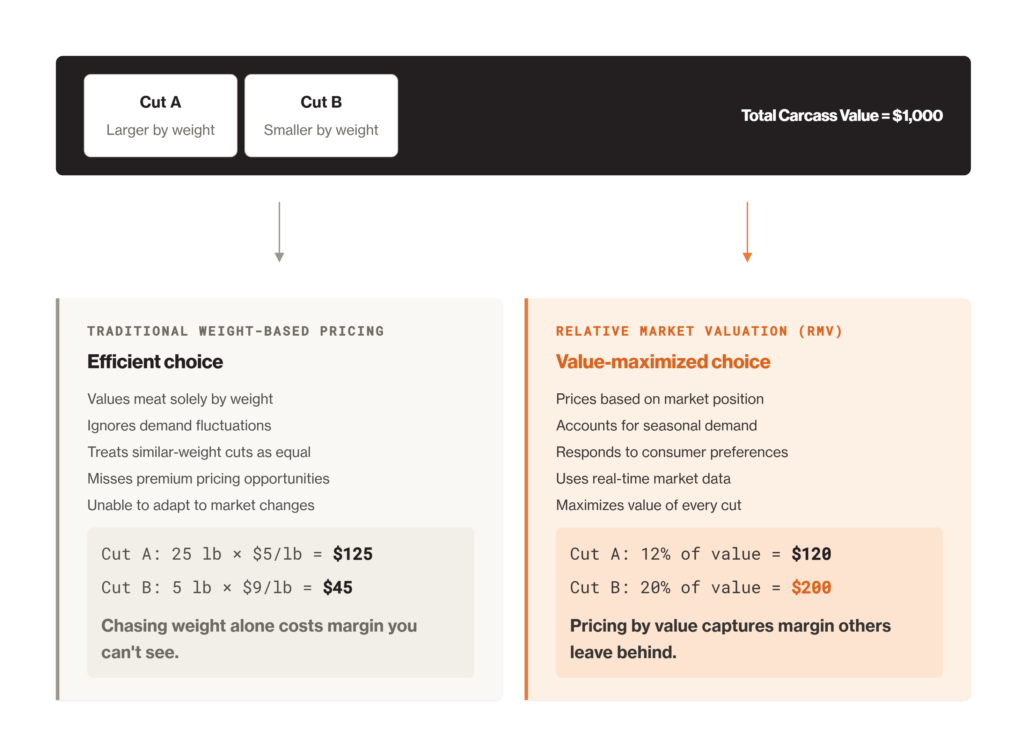
That’s the shift RMV makes possible: from ranking cuts by weight to ranking them by the value they actually return.
Why this matters for the decisions processors make every day
The efficient choice, produce more of whatever weighs the most, is not the same as the value-maximized choice, produce according to true market position. Processors making decisions on weight alone are optimizing for the wrong number.
Cut-level visibility built on RMV changes what’s possible:
- Prioritize the right cuts and reduce excess inventory instead of overproducing low-value volume.
- Capture up to 15 percent more value per carcass by aligning cuts with actual demand.
- Stay agile as market prices shift, rather than reacting after the fact.
- Focus labor on the cuts that generate the most value, not just the most weight.
In a low-margin, high-variability industry, the companies that know the value of every cut make faster, more confident decisions on product strategy, pricing, and customer focus. The ones still pricing by the pound are working with half the picture.
How ImpactECS puts this into practice
Seeing the concept is one thing. Running it against real carcasses, real market prices, and real customer orders every day is another. ImpactECS gives processors the tools to make that shift operational.
- Model carcass value allocation directly. ImpactECS calculates each cut’s share of total carcass value based on live market pricing, not a fixed weight ratio, so the allocation moves with the market instead of lagging behind it.
- Track cut-level profitability alongside disassembly and yield data. Product costing in ImpactECS connects directly to BOM and routing structures, so cut value and production cost sit in the same model instead of separate spreadsheets.
- Run scenarios before committing to a mix. Processors can model different disassembly and pricing strategies against current market conditions, comparing the efficient choice against the value-maximized choice before locking in a production plan.
- Respond to price and demand shifts as they happen. Because ImpactECS pulls in current market data, cut valuations update as conditions change, keeping pricing and mix decisions grounded in what the market is paying now.
- See profitability by customer and channel, not just by cut. The same model that values a cut can trace that value through to which customers and channels are actually driving margin, connecting product strategy to commercial strategy.
Processors using ImpactECS this way move past static, weight-based assumptions and toward pricing and production decisions built on where the value actually sits, carcass by carcass, cut by cut, customer by customer.