
AI Should Never Get the Last Word on a Cost Number
Every number that lands in a report, in front of a customer, or in front of the board eventually needs a defense. Four questions decide whether that defense holds up. What is this number built on? Why did it move? Who does it actually belong to? What happens if the ground underneath it changes? Most finance and operations teams only ever prepare for the first two. AI in cost analysis can speed up every one of those checks. It doesn’t settle any of them alone.
The four aren’t interchangeable. Each one interrogates a different way a number can fail. What it’s built on checks whether the model behind a number can actually see the variation that matters. Why it moved checks whether an explanation is complete. A true answer that stops short of the whole story is more dangerous than an obviously wrong one. Who it belongs to checks whether a shared cost is landing where it should. That’s a question data alone can’t settle. What happens if the ground shifts checks whether a number built for today’s conditions still holds once someone acts on it, especially when that action is what changes the conditions. Skip any one of them, and that particular kind of exposure goes unmanaged. It surfaces on its own, usually in front of whoever’s least prepared to explain it.

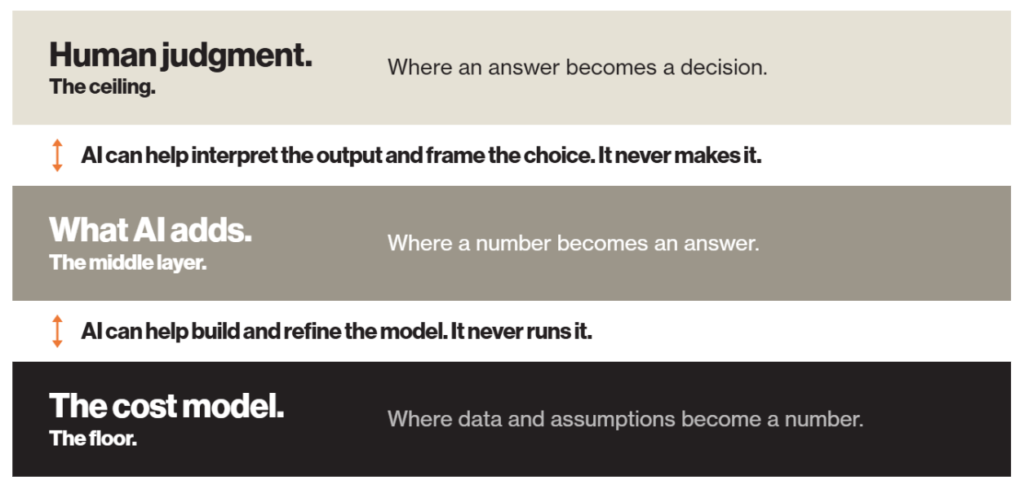
AI has a real, growing role in answering all four questions above. It also has a hard boundary that’s easy to lose track of once a tool starts sounding confident. The clearest way to think about that boundary is in three layers. The cost model is the floor: nothing above it means anything if it isn’t solid. AI is the middle layer. It adds real speed, entirely borrowed from whatever the floor already computed. A person is the ceiling, the one who decides what an answer actually means. AI can help build and refine the floor, but it never runs the floor unsupervised. It can help interpret the middle layer’s output, but it never owns the decision sitting on top of it.
It helps to separate that middle layer into two distinct directions, since they’re easy to blur together. Pointed down, into the model, AI can help structure an allocation, draft a worksheet, or design a cost driver, the same way it helps someone build out a spreadsheet formula or a script. That’s a one-time, auditable use. Once the model is built and running, AI drops out of the loop on what the model actually calculates, and inputs still have to match outputs the same way they always did before AI entered the picture.
Pointed up, out of the model, AI can translate whatever the model produces, a variance, a cost-to-serve breakdown, a scenario result, into something the next person in the room can act on without opening the model themselves. Both directions still end at a person. One decides what’s worth asking the model in the first place. The other decides what’s worth trusting once the answer comes back.
Four real situations make that boundary concrete.
What it’s built on
This question sounds like it should already have an answer, since every cost number rests on something. It’s also the one most likely to go unchecked. A model that balances is easy to mistake for a correct one, but balancing and fitting the business aren’t the same thing.
A large poultry processor ran breeder farms, hatcheries, and processing operations under one blended allocation method. That method never accounted for cut, range, location, or market value moving independently. Labor specifically used several different bases, per bird, per kilogram, and tray-based rates, and nothing tied a given basis to a given kind of production run.
Ask an AI tool for one run’s labor cost, and it answers instantly and confidently, using whatever basis happens to already be configured. Push it to compare that number against the other two bases, and the range can be dramatic, tens of thousands of dollars apart on a single run. Ask why, and a capable tool can reason it out: a per-bird rate tends to fit whole-bird or bone-in runs, where labor tracks headcount. A tray-based rate fits packaging lines, where labor tracks tray count. A per-kilogram rate fits trimmed, weight-based cuts. That reasoning is real and useful. Nobody enforces it. Nothing in the model ties a basis to a run type, so whichever convention is already running becomes the answer, whether or not it’s the one that actually fits.
That’s the pattern worth sitting with. AI can calculate under any basis and reason about which one usually fits, once someone asks. It won’t raise that question on its own, and it can’t know when the business has changed enough that “usually fits” no longer applies. Choosing a basis, and remembering to revisit it, is still a person’s job.
Why it moved
This is the most dangerous question to answer too fast. A wrong explanation rarely feels wrong. It feels like an answer. The moment a plausible cause shows up, the temptation is to stop looking for a second one.
A large apparel manufacturer ran five disconnected cost systems, including spreadsheets, on top of an ERP already in place. The ERP calculated a lot. It never connected manufacturing, shipping, and order data well enough to explain why a specific customer’s margin actually moved.
Consider a customer whose margin misses plan by enough to get flagged before the next leadership review. Asked what’s driving it, an AI tool can decompose the number in seconds and land on a real, correct answer: a price concession from earlier in the year accounts for a meaningful chunk of the shortfall. That’s genuine analysis, not a guess. It’s also not the whole story. A real gap can remain, and a capable tool says so plainly instead of papering over it. Sometimes it even admits that nothing else in its own data points to a cause, and that the rest of the answer needs information nobody gave it.
That admission is the moment that matters most. Only once someone pulls the missing piece, shipping records, contract terms, whatever lives outside the model, does the second effect surface. A shift from standard ocean freight to expedited air on a handful of shipments, never repriced, can close nearly all of the remaining gap.
The risk isn’t a wrong answer. It’s a true, partial answer that looks complete. Nothing forces anyone to ask what else might be driving the rest of a number. Recognizing that a partial explanation isn’t the full one, and knowing to go get what the model doesn’t have, is still a person’s job.
Who owns it
This question isn’t really about data at all, even though most teams treat it like one. Two departments can agree on every input and still disagree about who should carry a shared cost. No amount of additional analysis settles that by itself. At some point it becomes a scope decision, not a calculation.
A large, multi-branch electronics distributor tracked gross margin well. It had no visibility into warehouse handling, delivery, counter sales, or credit services cost. Leadership could see revenue and margin by customer. It couldn’t see true net contribution.
Two accounts can look identical on revenue and gross margin and still land tens of thousands of dollars apart once someone connects delivery and handling cost to the actual customer and transaction, the kind of activity-based view that’s hard to build after the fact. Asked why, AI can explain the driver in seconds: one account ships high-volume, standard product in full cases, the other leans toward specialty, low-volume items that cost more to handle per dollar of revenue. That’s a real answer, and it’s fast.
It isn’t the end of the question, though. Companies often spread credit and collections costs evenly across every account by default, not because that’s accurate, but because nobody built a way to track them by driver. AI can do the math on what changes if that cost shifts to whoever’s actually generating the collections effort instead. What it can’t do is decide that attribution is the fair way to treat the account. That isn’t a data gap AI will eventually close. It’s a policy call that was never AI’s to make in the first place.
What happens if the ground shifts
This is the question most teams skip entirely, because it isn’t about anything that’s happened yet. It’s also the one where the answer can undo itself. A number can be perfectly defensible the moment someone calculates it and still be the wrong number by the time anyone acts on it.
A team builds a fully optimized production plan: shift extra volume onto whichever line shows the lowest cost per unit on file. Every rate is current. Every calculation checks out. (This next example is illustrative rather than drawn from a specific customer, built to show a distinct failure mode.)
Asked which line should absorb the added volume, AI recommends the cheaper option and quotes a clean savings figure. Pushed on whether that rate accounts for the line switching between products more often than its historical pattern, the honest answer is no. The cheap rate assumed one long production run a quarter. The new plan requires switching monthly, which adds changeover cost the rate never counted. Real savings end up a fraction of what was first quoted.
This is a sharper failure than the first three, and worth naming on its own. AI didn’t miss something sitting in the data, and this isn’t a fairness call needing a person’s judgment. The decision itself broke its own assumption. AI can rank options by cost in seconds. It can’t know that assigning the work is exactly what invalidates the number it just produced. The useful response isn’t to distrust the tool, it’s to treat any forward-looking number as provisional: approve the plan, and commit to retesting it once real data comes in, rather than treating a projection as settled.
What AI in cost analysis still needs from a person
Lined up together, the four failures aren’t variations on one theme, they’re different in kind. The first is a model too blunt to see real variation. The second is a true answer that stops short of being the whole one. The third is a shared cost that data alone can’t fairly divide. The fourth is a decision that quietly invalidates its own premise the moment someone makes it. None of these four numbers were wrong because the math was wrong. In every case, the model did its job. AI did its job. A person was still necessary, to catch what neither could see, or to own a call that was never theirs to make.
That’s a useful discipline to apply to any number before acting on it. What is it built on? Why did it move? Who does it actually belong to? What happens if the ground underneath it changes? AI can move fast on all four questions. It’s still worth someone’s job to keep asking them.
Finance and operations teams that want AI in cost analysis to be genuinely useful, not just fast, need a cost model detailed enough to support these four questions in the first place. That floor is the layer worth getting right before anything else. Teams who have already built that floor are worth a look before starting from scratch, see 3C Software’s customer stories for a few. 3C Software’s ImpactECS platform connects data across systems and models how costs actually behave, giving finance and operations leaders a foundation they can trust before they ever ask an AI tool to build on top of it.