
The Good, the Bad and the Unprofitable
Discounts, firm-price requests, and renewal discounts are all cost decisions. Finance has the numbers to make them well, if those numbers reach the table in time.
Every pricing negotiation reaches the same moment. A key customer asks for 5% off at renewal. A buyer wants a firm 12-month price on a custom part while your material costs are still moving. Someone across the table makes an offer, and someone on your side has to decide: can we live with that?
That decision usually gets made in sales or procurement. But the number it depends on, what this deal actually costs, sits with finance. And too often it reaches the table as a standard cost, an average margin, or last year’s rate. Those numbers are fine for the books. They’re the wrong numbers for a deal.
The result is discounts approved on instinct, with nothing on the P&L – no flagging off bad deals until months later. The fix isn’t tougher negotiators. It’s getting deal-level cost into the room before anyone says yes.
Key takeaways
- Every discount is a cost decision. A discount, a firm price, or extended terms comes straight out of margin, whether or not anyone models it.
- Standard costs and averages hide the deal-level number. Material swings, order patterns, service intensity, and terms can move the cost of the same product by double digits from one customer to the next.
- A walk-away price gives the commercial team room to trade. With it, a flat no on a discount becomes a counteroffer on volume, lead time, or terms.
- In manufacturing, the hard part is often cost you don’t know yet. Price structure can protect margin where a cost estimate can’t.
- Make the cost check a standard step in quoting and renewals, owned by finance and fast enough for sales to use.
Why standard cost falls short at the table
Standard costs and blended overhead rates do their job: they value inventory and keep the books consistent. But they spread cost evenly across products and customers that don’t consume it evenly. In a negotiation, that averaging hides exactly the number you need. Five gaps show up again and again:
- Material costs that have already moved. Standards set once a year miss what’s happened since, and quotes for new or custom work often involve material you haven’t bought yet.
- Example: resin costs rise 12% in Q2, but the standard still reflects January pricing, so every quote through year-end understates material cost.
- Averaged overhead. Overhead spread by volume or revenue makes low-volume, high-complexity items look cheaper than they are.
- Example: a custom SKU that needs two extra setups per run carries the same overhead rate as a high-volume standard item, and gets quoted at the same margin.
- Cost to serve that never reaches the customer. Freight, order handling, returns, rush orders, and service time sit in SG&A instead of in the customer’s margin.
- Example: two customers buy $500,000 a year of the same product. One orders full truckloads monthly; the other places 40 small orders with frequent expedites. On paper, they’re equally profitable.
- Terms nobody charges back. Payment terms, rebates, consignment inventory, and volume incentives rarely show up in product cost.
- Example: moving a customer from net 30 to net 90 to close a renewal ties up working capital that nobody charges back to the deal.
- Landed cost on the supply side. The invoice price leaves out duties, freight, quality issues, and minimum order quantities.
- Example: a supplier offering a 4% lower unit price requires 3x larger minimums, and the added carrying cost wipes out the savings.
None of these look like errors. The quote looks reasonable, the deal closes, and the margin is just lower than anyone expected.
Give the team a walk-away price
The most useful thing finance can hand a negotiator is three numbers: what the deal costs, the lowest price you’ll accept, and the price you’re aiming for. List price tells them where they started. Deal-level cost tells them where the edge is.
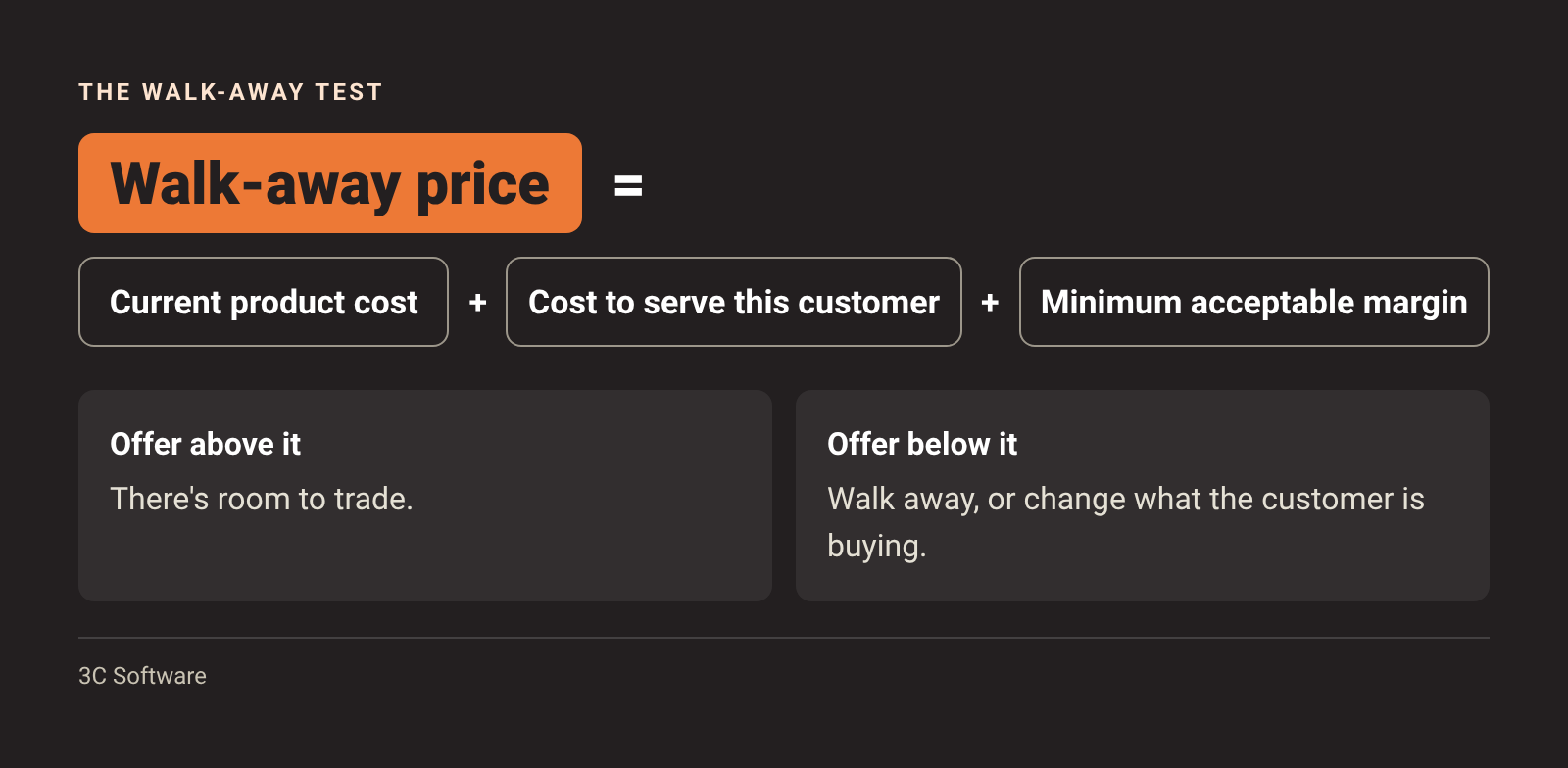
Above it, there’s room to trade. Below it, either walk away or change what the customer is buying, so the cost underneath the price changes too.
That second option is where the leverage is. Every cost driver finance can see is something the commercial team can trade:
- Order size and frequency for a lower unit price
- Delivery schedule or lead time for avoiding expedite costs
- Payment terms for a price discount
- Product mix or specifications for removing costly customizations
- Contract length or volume commitment for better utilization on your side
One caveat. A deal below fully loaded cost isn’t always wrong. If it covers variable cost and fills idle capacity, it can still add to profit. The point isn’t to never go below a number. It’s to know which number you’re going below, and why.
Example 1 · Manufacturing: the firm-price request on a part you can’t fully cost yet
A contract manufacturer is renewing a 12-month supply agreement for a custom molded assembly, about 50,000 units a year. The customer wants two things: a firm price for the full year, and 3% off last year’s $40.00, bringing it to $38.80.
On standard cost, that’s an easy yes. The problem is material, which makes up most of the cost and is still moving. Recent resin buys are running above standard, the customer’s spec change calls for a higher-grade material the plant hasn’t bought in volume, and smaller release quantities have added setups.
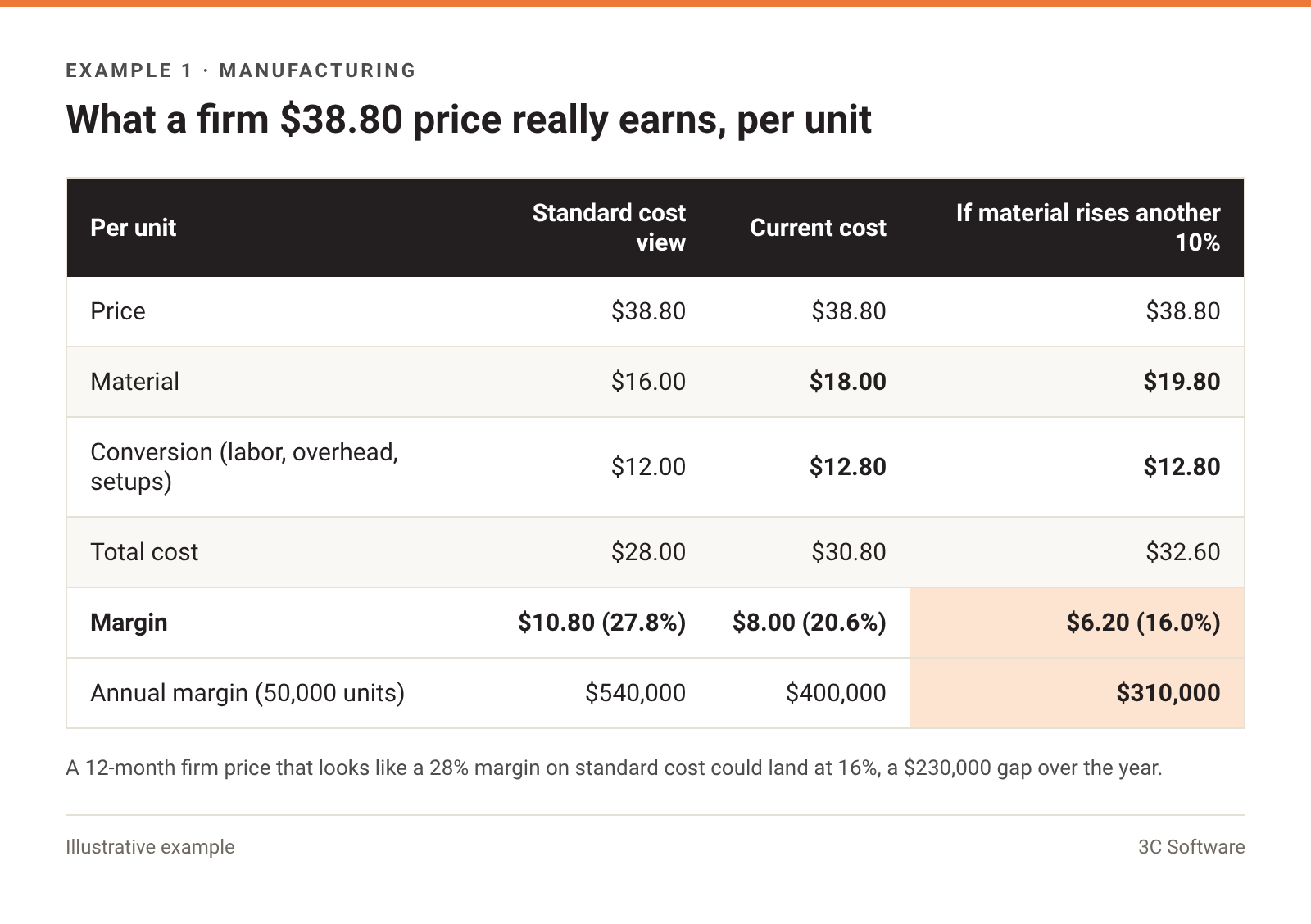
A firm price at $38.80 looks like a 28% margin. In practice it could land at 16%, a $230,000 gap over the year, and every dollar of material movement comes out of the manufacturer’s margin.
The pricing conversation
Finance can’t promise what resin will cost in Q3. What it can do is help structure the price so the unknown part doesn’t sit entirely on one side. Instead of a flat no on the firm price, the team goes back with three moves:
- Split the price into conversion and material. Hold the conversion portion firm for 12 months. That’s the part the plant controls.
- Tie material to a published index or a quarterly review, so cost movement passes through in both directions. If resin prices fall, the customer benefits too.
- Give the 3% in exchange for larger releases. Minimum releases of 5,000 units remove the extra setups and bring conversion back to $12.00.
The result: price of $38.80 (3% off, as the customer asked), conversion held at $12.00 with larger releases, and a 22.7% margin at today’s material cost, with material movement passed through.
The customer gets the discount and price certainty on the part of cost the plant controls. The manufacturer stops underwriting a material market it can’t predict. It only works if finance can produce a current material cost, a clean split between material and conversion, and a fast re-quote when the index moves.
Example 2 · Distribution: the 5% discount that would have cut margin by 45%
A distributor sells $500,000 a year of the same product line to two customers. Warehouse and delivery costs are allocated by revenue, so both accounts look identical: an 18% margin. Then Customer B asks for 5% off at renewal.
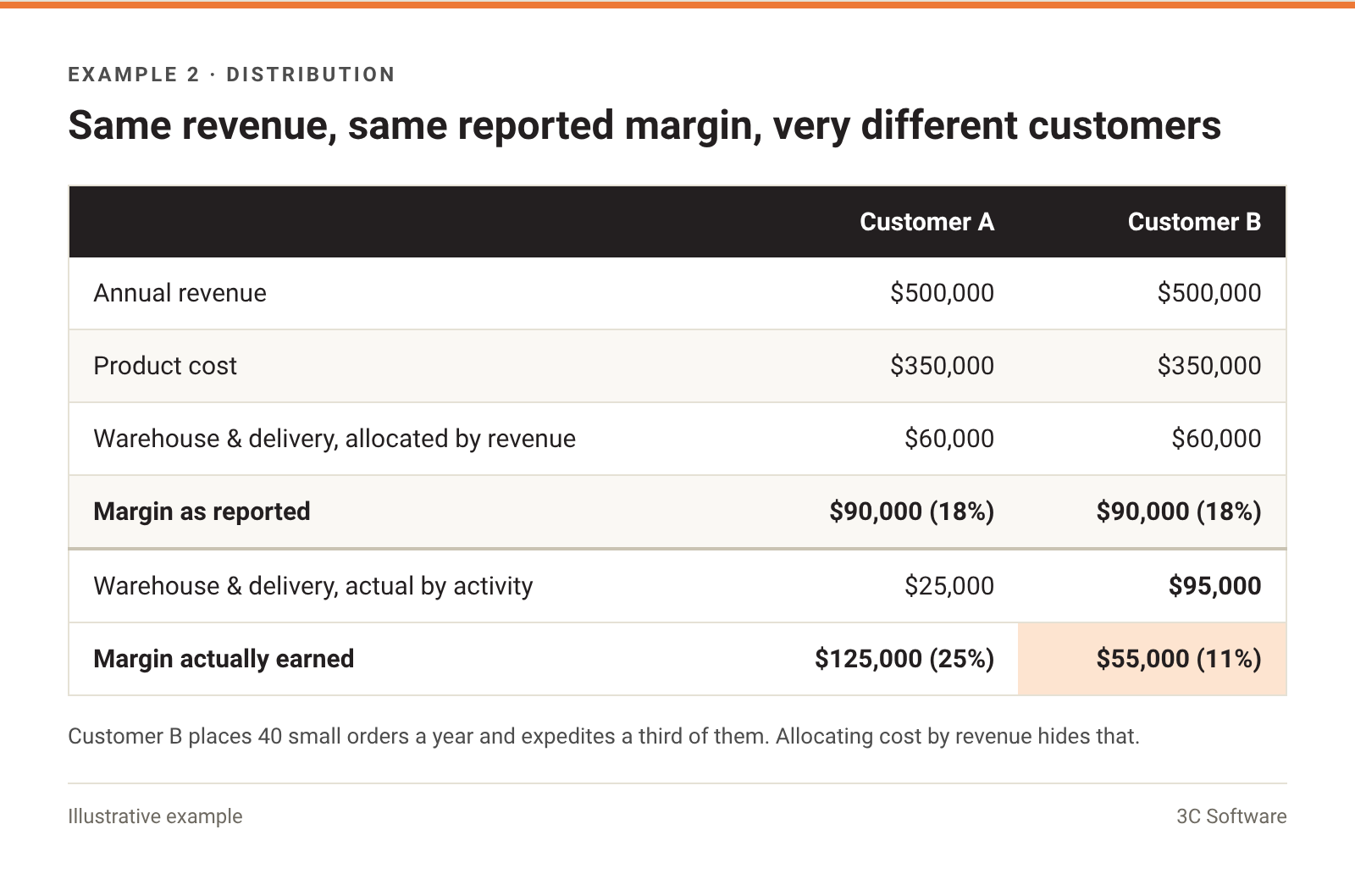
Customer B places 40 small orders a year and expedites a third of them. A 5% discount ($25,000) would cut its margin from $55,000 to $30,000, a 45% drop, on an account the reports say is healthy.
Offered instead: 3% off in exchange for consolidated twice-monthly orders and no routine expedites. Cost to serve drops to about $50,000 (from $95,000), and margin lands at 17.5%: $85,000 on $485,000, or $30,000 more than before.
The rep doesn’t have to say no. The customer gets a lower price, and the business earns $30,000 more than before the negotiation started. None of it was possible while the reports showed both customers at 18%.
What cost data can and can’t do
Accurate cost data tells you where your limits are. It doesn’t tell you what the other side will accept. Those are different questions, and mixing them up is how a well-informed team still leaves money on the table.
| What it can do | What it can’t do |
| Move the talk from price to cost drivers. Propose changes that lower cost for both sides instead of arguing over one number. A customer pushing for a lower price may accept a longer lead time that lets you batch production and cut setup cost by 8%. | Replace judgment. Cost data won’t tell you how much a customer values the relationship, what a competitor is really offering, or whether a strategic account is worth a thinner margin this year. |
| Defend price with facts. Show what’s built into your price: delivery reliability, smaller minimums, engineering support. | A deal can clear the walk-away price and still be the wrong deal, or fall below it and still be the right one. |
Cost data tells you what a deal is worth to you. The commercial team’s judgment tells you what it’s worth to win. Finance’s job is to make sure the first number is in the room.
Making it part of the process
This matters most when any of these apply:
- Customers ask for discounts at renewal. Discount requests, rebate increases, or term changes come up on a regular cycle.
- Material or input costs are moving. Tariffs, freight, materials, or labor shift faster than standards are updated.
- Cost to serve varies widely. Customers differ in order size, delivery needs, service requirements, or channel.
- Sales quotes without finance in the room. Reps need to know their limits without waiting days for a margin review.
- Supplier pricing is under pressure. You’re evaluating new sources or responding to increase notices.
To make it stick, treat the cost check as a standard step that finance owns, not a special project:
- Cost your top accounts and top suppliers, including cost to serve and landed cost, before renewal season.
- Set a walk-away price and target margin for each major deal before the first conversation.
- Give sales a short list of tradeable cost drivers for each account: order size, frequency, terms, specs.
- For quotes with volatile or unknown material, separate material from conversion so the price structure can carry the risk.
- Model every proposed discount against deal-level margin before it’s offered, not after it’s signed.
- Refresh costs when inputs move, not just at the annual standard-cost reset.
- After each deal, compare actual margin to what you modeled, and track discounts by account over time.
Once the cost data is in place, the check takes minutes. It won’t win every negotiation, but it keeps you from losing the ones you thought you won.
Frequently asked questions
What’s the difference between standard cost and deal-level cost?
Standard cost is a planned or averaged cost used for accounting and inventory. Deal-level cost reflects what a specific product, customer, or order actually consumes, including cost to serve, landed cost, and current input prices. The two can differ significantly for low-volume, high-service, or custom business.
How do you quote when material costs are uncertain?
Separate the price into what you control and what you don’t. Hold conversion firm, tie material to an index or a scheduled review, and keep quote validity windows short when markets are moving. A current cost model makes re-quoting fast enough that this doesn’t slow sales down.
How do you calculate cost to serve?
Identify the activities each customer drives, such as order processing, picking, freight, expedites, returns, and service calls. Assign the cost of each activity based on how much each customer uses it. The result shows which customers are profitable once those costs are included.
Should you ever accept a deal below full cost?
Sometimes. A deal that covers variable cost and uses spare capacity can still add to profit, and a strategic account may justify a thinner margin. The key is making that choice deliberately, with the real numbers in front of you.
How often should cost data be updated for negotiations?
Before every major renewal or quote, and whenever key inputs like materials, freight, or tariffs move meaningfully. Annual standards alone are rarely current enough.
Closing thought
It’s not enough for the commercial team to know list price and target margin. They need to know what each deal costs, where the walk-away price is, and which cost drivers they can trade. Getting that number to the table is one of the most direct ways finance protects margin.
Try this test: If your largest customer asked for 5% off tomorrow, how long would it take finance to tell sales what that costs? If the answer is days, or “we’d have to guess,” start with your top ten accounts.
How ImpactECS helps finance get cost to the table
The hard part isn’t knowing that deal-level cost matters. It’s getting accurate, current cost and margin data for every product, customer, and supplier to the people negotiating, fast enough to use. ImpactECS, the cost and profitability platform from 3C Software, helps finance teams do that:
- Current product costs. Built from bills of material, routings, and rates in one connected model, with material and conversion kept separate.
- Profitability by customer. Cost to serve by customer, channel, and order pattern.
- Cost-based quoting. Sales prices from current cost and delivery data, and re-quotes quickly when inputs move.
- Landed cost on the supply side. Compare suppliers on freight, duties, and supply chain costs.
- Scenarios before commitments. Model a discount, a term change, or a material index clause before you agree to it.
This article was contributed by 3C Software for the PACE community.