
AI Needs a Cost Foundation It Can Trust
Every profitability analyst has had this moment: a number looks wrong, and the only way to know for sure is to trace it back through the model, step by step, until the source of the distortion turns up. It’s slow work. It’s also the work that makes the number trustworthy once you’re done.
AI promises to skip that process. Ask a question, get an answer, move on. For finance and operations teams under pressure to answer faster, that’s an appealing trade. But it raises a question every practitioner in this field should be asking before they act on an AI-generated number: trustworthy according to what?
The honest answer is that AI is only as good as the cost structure it’s reasoning over. A language model can process enormous volumes of data and generate a fluent, confident answer in seconds. What it cannot do is compensate for a cost model that was never built to support that kind of scrutiny. If the underlying allocations are broad averages, if product and customer economics are blended rather than modeled separately, if the data structure doesn’t reflect how the business actually operates, AI doesn’t correct for that. It reasons over the noise as though it were signal, and it does so with total confidence.
That’s the real risk with AI in cost and profitability work. Not that the models are wrong, but that they’re wrong in a way that sounds right.
Where the Confidence Comes From, and Where It Should Come From
Language models are built to produce fluent, well-formed answers. Fluency and accuracy are not the same thing, and cost analytics is a domain where that gap can be expensive. A model asked to explain why margin dropped on a customer segment will produce an explanation regardless of whether the underlying data supports one. If the customer-level cost detail doesn’t exist, the AI will still generate a plausible-sounding narrative, built from whatever correlations it can find in the data it has access to.
For a profitability analyst, this should sound familiar. It’s the same failure mode as a poorly designed allocation methodology: technically defensible, procedurally clean, and directionally wrong.
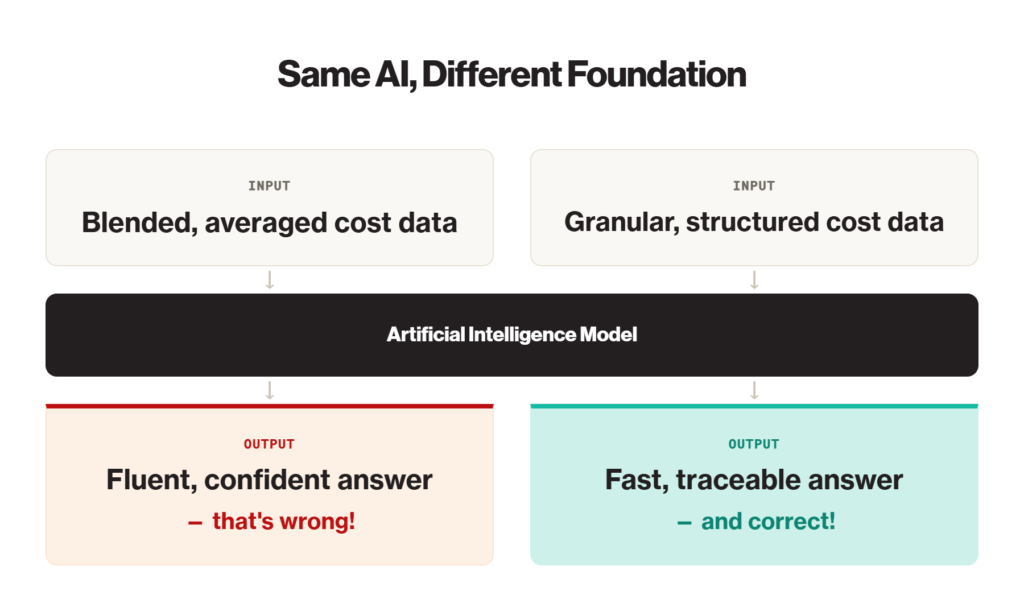
The fix isn’t a better prompt. It’s a better model, in the cost accounting sense of the word: costs assigned at the right level of granularity, allocation logic that reflects actual cost drivers rather than approximations, and a consistent framework connecting product, customer, channel, and operational data. AI performs well when it’s reasoning over structure like that. It performs badly when it’s asked to make sense of blended averages and calls the result insight.
What This Changes About the Analyst’s Job
There’s a version of this conversation that treats AI as a threat to the profitability analyst’s role. That’s not the more useful framing. The more useful framing is that AI shifts where analyst judgment is most needed.
Less of that judgment goes into producing the answer. AI can surface cost drivers, summarize variance between scenarios, and explain a calculation in plain business language faster than a person building the same explanation manually. That’s real time saved, and it’s the part of the AI conversation that gets the most attention.
More of that judgment needs to go into validating the model AI is reasoning over, and into reviewing the outputs it produces. That’s a less visible shift, but it’s the one that determines whether AI actually improves decision quality or just increases the speed at which bad numbers circulate. An analyst who understands where the allocation logic is thin, where the data has gaps, and where a variance explanation should be double-checked against the underlying drivers is more valuable in an AI-assisted environment, not less. The tools don’t replace that judgment. They depend on it.
The Governance Question Practitioners Can’t Skip
This is where the conversation usually needs to go further than “make sure the data is good,” because good data alone doesn’t answer the questions a controller, an auditor, or a regulator will eventually ask about an AI-generated number.
Those questions are procedural. Where did this number come from? What logic produced it? Who had access to generate it? Can the reasoning be reviewed after the fact? A cost model can be perfectly granular and still fail this test if the AI layer sitting on top of it operates as a black box.
For AI to hold up in enterprise cost and profitability work, a few things need to be true at the same time. Access needs to follow the same role-based boundaries that already govern the underlying model, so AI doesn’t become a way around existing data controls. The path from a natural-language question to the answer needs to be traceable, so a reviewer can see not just the output but the structured query and logic that produced it. And the reasoning behind a given AI output needs to connect back to something a human can inspect: a modeling pattern, a calculation, a data source, not just a generated sentence that sounds like an explanation.
That combination, access control, traceability, and explainability, is what separates AI that’s usable in a regulated or audited environment from AI that’s useful only in a low-stakes exploratory setting. For most of the industries PACE members work in, that’s not an academic distinction. It’s the difference between a tool finance can actually adopt and one compliance will eventually shut down.
Speed Is the Easy Part
It’s worth saying plainly: the speed benefit is real. Getting an answer to “why did margin move on this account” in seconds instead of a day of pulling data is a genuine improvement in how fast an organization can respond to a problem. Faster variance explanations, faster scenario comparisons, faster onboarding for new analysts trying to understand how an existing model works: these are legitimate gains, and they’re the reason AI adoption in this space is accelerating.
“A bad number produced instantly looks exactly like a good one, until someone has to explain it in an audit.”
But speed was never the hard problem in cost and profitability analytics. Getting a fast answer has always been possible if you’re willing to sacrifice rigor for it. The hard problem, the one this profession exists to solve, is getting a fast answer that’s also correct, defensible, and traceable. AI doesn’t change that equation. It just makes it more visible, because a bad number produced instantly looks exactly like a good one, until someone has to explain it in an audit.
A Practical Starting Point
For teams evaluating where AI fits into their cost and profitability work, a few questions are worth asking before the tool selection conversation:
- Does the underlying cost model reflect how the business actually operates, or does it rely on allocations that were built for a simpler analysis than the one AI is now being asked to support?
- Can every AI-generated answer be traced back to the query and logic that produced it, in a form a reviewer could actually follow?
Does AI operate inside the same access boundaries as the rest of the organization’s data controls, or does it introduce a separate path to information that should be restricted?
If the honest answer to any of these is “not yet,” that’s not a reason to avoid AI. It’s a sequencing problem. The cost structure and the governance controls come first. AI built on top of that foundation earns the confidence it projects. AI built on top of anything less is just producing fluent guesses faster than before.
The organizations that get the most out of AI in cost and profitability analytics won’t be the ones that adopted it first. They’ll be the ones that had a cost model worth trusting before they asked AI to reason over it.
The Foundation This Requires
This is the problem ImpactECS was built to solve before AI ever entered the conversation. The platform connects cost data across systems, applies allocation logic based on real cost drivers instead of averages, and organizes results by the dimensions that actually matter: product, customer, channel, plant. That structure is what makes AI answers worth trusting in the first place. When AI reasons over a model built this way, the result isn’t a fluent guess. It’s an answer grounded in the real economics of the business, traceable back to the logic that produced it. That’s the foundation the next generation of cost and profitability analysis needs to be built on.